
How to Balance pH Levels in a Saltwater Pool
A saltwater pool can be an enjoyable and convenient way to spend time with family and friends, but like any swimming pool, it requires regular water testing and maintenance.
One of the most important aspects of saltwater pool maintenance is keeping the pH within the recommended range. Proper pH balance helps maintain swimmer comfort, supports effective chlorine performance and reduces the risk of scaling, corrosion and equipment problems.
Although saltwater pools use a salt chlorine generator instead of requiring regular manual chlorine additions, they still need routine testing and chemical balancing.
Table of Contents
Maintaining pH Levels in Saltwater Pools
A saltwater pool uses a salt chlorine generator to produce chlorine from dissolved sodium chloride through an electrolysis process.
As pool water passes through the generator’s electrolytic cell, chlorine is produced and used to sanitize the water. The chlorine then changes through a series of chemical reactions and is eventually converted back into chloride, allowing the process to continue.
The salt chlorine generator helps automate chlorine production, but it does not automatically maintain the correct pH level. Pool owners still need to test and adjust pH and other water chemistry parameters regularly.
What Should the pH Level Be in a Saltwater Pool?
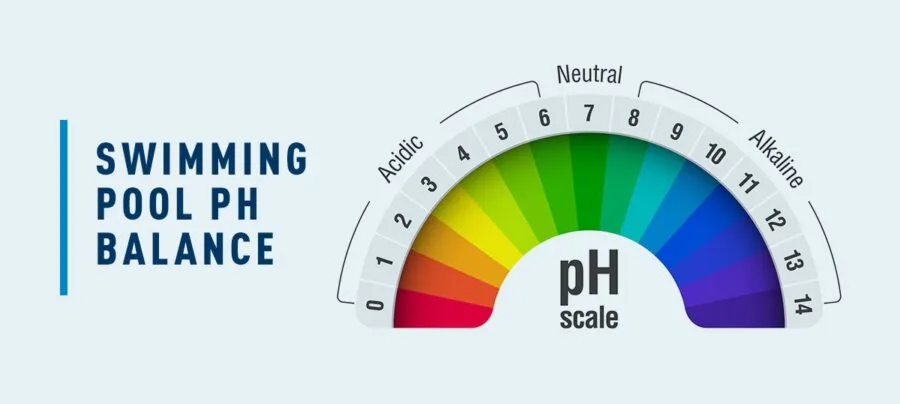
The recommended pH range for most swimming pools is approximately 7.2 to 7.8, with around 7.4 to 7.6 generally considered a comfortable target.
It is also important to monitor total alkalinity, which helps stabilize the pool’s pH and prevent rapid fluctuations.
A commonly recommended total alkalinity range for swimming pools is approximately 80–120 ppm, although the appropriate target can vary depending on the pool system and the chemicals being used.
Regularly testing both pH and alkalinity provides a better picture of overall water balance than testing pH alone.
How to Test the pH of a Saltwater Pool
There are several ways to test pool pH, including:
- Liquid reagent test kits
- Digital water testers
- Pool test strips
Whichever method you use, follow the instructions provided with the testing equipment.
For more reliable results:
- Collect the water sample according to the test manufacturer’s instructions.
- Avoid collecting samples immediately next to return jets or chemical dosing points.
- Test pH and alkalinity regularly.
- Check chlorine levels separately.
- Keep testing equipment clean and properly stored.
Test results can sometimes be affected by sampling technique, water temperature, testing equipment and other water chemistry factors.
Why Does pH Increase in a Saltwater Pool?
One of the most common maintenance challenges in saltwater pools is gradually increasing pH.
Salt chlorine generators can contribute to upward pH drift because the electrolysis process produces chemical reactions at the cell that can increase the water’s tendency toward higher pH.
Another important factor is total alkalinity. Alkalinity acts as a buffer that helps stabilize pH. If alkalinity is too high, however, it can make pH more difficult to control and may contribute to persistent upward pH movement.
Other factors, including aeration, water temperature and the pool’s overall chemistry, can also influence pH.
Effects of High pH in a Saltwater Pool
When pool pH rises above the recommended range, several problems can occur.
Swimmer Discomfort
High pH can contribute to eye irritation, dry or uncomfortable skin and an unpleasant swimming experience.
Cloudy Water
An excessively high pH can contribute to cloudy or hazy water, particularly when calcium levels are also elevated.
Reduced Chlorine Effectiveness
As pH rises, the effectiveness of chlorine as a sanitizer decreases. This can make it more difficult to maintain adequate sanitation and may contribute to algae or bacterial growth if chlorine levels are not properly managed.
Calcium Scaling
High pH can increase the likelihood of calcium carbonate scaling, particularly when calcium hardness is also high.
Scale can accumulate on pool surfaces, inside plumbing and around the salt chlorine generator cell. Heavy buildup can reduce equipment efficiency and increase maintenance requirements.
How to Lower the pH in a Saltwater Pool
If testing shows that the pH is too high, it can generally be lowered using an appropriate pool acid, such as:
- Muriatic acid (hydrochloric acid)
- Sodium bisulfate (dry acid)
Always follow the product manufacturer’s instructions and use the recommended quantity based on your pool volume and current water chemistry.
Using Dry Acid
When using sodium bisulfate:
- Follow the manufacturer’s dosage instructions carefully.
- Check whether the product should be dissolved before application.
- Keep the pool circulation system running as directed.
- Distribute the chemical according to the product instructions.
- Avoid adding more chemical than recommended.
- Retest the water after the chemical has had sufficient time to circulate.
Using Muriatic Acid
Muriatic acid is a strong chemical and should be handled carefully.
When using it:
- Follow the manufacturer’s instructions.
- Wear appropriate protective equipment.
- Never mix muriatic acid with chlorine or other pool chemicals.
- Add the product carefully to the pool as directed.
- Keep the circulation system operating according to the product instructions.
- Allow the water to circulate before retesting.
Always follow local safety requirements and the chemical manufacturer’s handling instructions.
How to Increase the pH in a Saltwater Pool
If the pH is below the recommended range, the appropriate correction depends on the pool’s pH and total alkalinity levels.
For raising pH, soda ash (sodium carbonate) is commonly used.
If both pH and alkalinity are low, sodium bicarbonate (baking soda) is generally used to raise alkalinity with a comparatively smaller effect on pH.
Using Soda Ash
When pH needs to be increased:
- Follow the manufacturer’s dosage instructions.
- Calculate the required amount based on your pool volume and current pH.
- Keep the circulation system running as recommended.
- Distribute the product according to the manufacturer’s instructions.
- Allow the chemical to circulate.
- Retest the water before making another adjustment.
Avoid adding large quantities at once. Making gradual adjustments makes it easier to reach the desired range without overshooting it.
What About Borax?
Borax can be used in some pool-maintenance approaches to raise pH while having a smaller effect on total alkalinity than some other products.
However, it should not be confused with boric acid.
Boric acid is generally used as a source of borate in some pool-water treatment strategies rather than as the primary chemical for raising pH. It should not be added simply to correct low pH unless specifically recommended as part of an appropriate pool treatment program.
Always follow the product instructions and verify the intended application before adding any chemical to your pool.
How to Increase Alkalinity Without Significantly Raising pH
If your pool’s total alkalinity is low, sodium bicarbonate (baking soda) is commonly used to increase alkalinity.
Unlike soda ash, sodium bicarbonate generally has a much smaller effect on pH, making it useful when alkalinity needs to be increased without substantially raising the pH.
The required quantity depends on:
- Pool volume
- Current total alkalinity
- Desired alkalinity level
- Product concentration
Rather than relying on a fixed amount for every pool, use a reliable pool chemistry calculator or follow the dosage instructions provided by the chemical manufacturer.
After adding the required amount, allow the water to circulate and retest both alkalinity and pH.
How to Lower pH Without Creating Other Water Chemistry Problems
Maintaining balanced pool water requires more than adjusting pH whenever it moves outside the target range.
For example, repeatedly adding acid can gradually reduce total alkalinity. If alkalinity becomes too low, pH may become unstable and fluctuate more easily.
For this reason, pool owners should monitor:
- pH
- Total alkalinity
- Free chlorine
- Calcium hardness
- Salt concentration
- Cyanuric acid, where applicable
Keeping these parameters within the recommended ranges helps maintain balanced pool water and supports the reliable operation of a salt chlorine generator.
Perform a Final Water Test
After making a pH adjustment, allow sufficient time for the pool water to circulate and the chemical to distribute throughout the pool.
Then test the water again.
For most saltwater pools, aim to keep the pH within approximately 7.2–7.8, or within the specific range recommended by your pool equipment and chemical manufacturer.
If the pH remains outside the recommended range, make another gradual adjustment rather than adding a large amount of chemical at once.
Regular testing is one of the simplest ways to prevent small water chemistry changes from developing into larger maintenance problems.
Tips for Maintaining a Saltwater Pool
Keeping a saltwater pool balanced does not have to be complicated. A consistent maintenance routine can help prevent many common problems.
Test the Water Regularly
Do not rely solely on the salt chlorine generator. Test pH, chlorine, alkalinity and other relevant parameters regularly.
Keep the Salt Level Within the Recommended Range
The correct salt concentration depends on the specific chlorine generator. Always follow the manufacturer’s recommended operating range.
Monitor Total Alkalinity
Proper alkalinity helps stabilize pH and can make long-term pH management easier.
Clean the Salt Cell When Necessary
Calcium deposits can accumulate on the electrolytic cell, particularly when water chemistry is not properly balanced. Follow the generator manufacturer’s instructions for inspection and cleaning.
Avoid Overcorrecting the Water
Make gradual adjustments and retest before adding additional chemicals. Overcorrection can create another water chemistry imbalance.
Final Thoughts
Maintaining the correct pH level in a saltwater pool is an important part of keeping the water comfortable, clear and properly sanitized.
A salt chlorine generator can automate chlorine production, but it does not eliminate the need for regular water testing. Monitoring pH, alkalinity, chlorine, salt concentration and other relevant parameters helps keep the pool water balanced and protects the pool equipment.
If the pH becomes too high, products such as muriatic acid or dry acid can be used to lower it. If the pH is too low, soda ash can be used to raise it, while baking soda is generally more appropriate when the main issue is low alkalinity.
By testing regularly and making gradual adjustments, maintaining a saltwater pool can be a straightforward part of your regular pool-care routine.
Quality Pool Salt from MOSES Salt
MOSES Salt Group Ltd supplies high-quality pool salt for saltwater swimming pools, along with a wide range of salt products for residential, commercial and industrial applications.
Our pool salt is available in bags and bulk quantities, providing flexible supply options for different pool and commercial requirements.
Contact MOSES Salt Group Ltd for more information about our pool salt, available packaging, delivery options and bulk supply.