
Rock Salt vs Table Salt: Key Differences, Uses, Processing & Nutrition
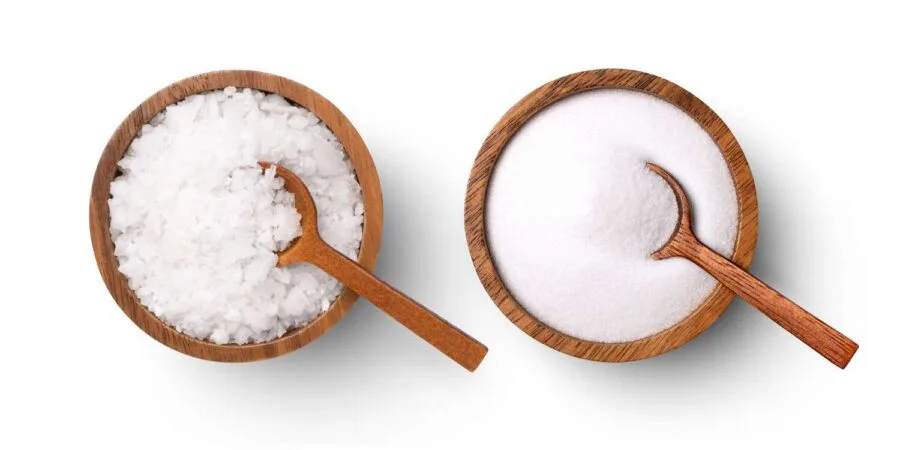
The main difference between rock salt and table salt is how they are processed. Rock salt is mined naturally as halite crystals and undergoes minimal processing, while table salt is highly refined to produce a fine, consistent product.
Both types are primarily made of sodium chloride (NaCl) and provide a similar amount of sodium by weight. However, they differ in processing, crystal size, texture, additives, iodine content, appearance, and common applications.
Table salt remains one of the most common ingredients found in households around the world. From everyday home cooking to professional kitchens, salt is used in different quantities and for a wide range of purposes.
At the same time, interest in alternative types of salt has grown, particularly rock salt. One reason for its increasing popularity is the perception that it is more natural or healthier than conventional table salt.
But is rock salt actually healthier than table salt? And which type should you choose for cooking, specialty applications, or industrial use?
In this guide, we’ll compare rock salt vs table salt in detail, including their definitions, processing methods, additives, texture, flavor, nutritional content, and common uses. We’ll also answer some of the most frequently asked questions about these two types of salt.
Table of Contents
Rock Salt vs Table Salt: Quick Comparison
| Feature | Table Salt | Rock Salt |
|---|---|---|
| Basic Definition | Refined sodium chloride designed primarily for cooking and table use. | The naturally occurring mineral form of sodium chloride, known as halite. |
| Processing | Highly refined, purified, and usually ground into fine crystals. | Minimally processed; generally mined, crushed, and screened. |
| Additives | May contain anti-caking agents and may be iodized. | Generally additive-free in its culinary form. |
| Texture & Grain Size | Fine, uniform, and powdery crystals. | Coarse, larger, and irregular crystals. |
| Color | Usually white. | May range from white to pink, brown, or gray depending on trace minerals. |
| Culinary Uses | General cooking, seasoning, and baking. | Finishing dishes, salt grinders, meat curing, and specialty applications such as salt blocks. |
| Non-Culinary Uses | Chemical and industrial processing. | Road de-icing, water softening, and various industrial applications. |
What Is Rock Salt?
Rock salt is the natural, minimally processed form of sodium chloride. It occurs naturally as the mineral halite, usually in solid masses.
Rock salt is extracted from underground deposits that are commonly associated with ancient seas that evaporated over geological periods. Because it requires relatively little processing, rock salt can retain naturally occurring trace minerals.
These minerals can influence the salt’s appearance, which means rock salt may be found in different colors, including white, pink, brown, and gray.
Rock salt crystals are typically larger and more irregular than table salt crystals. Depending on the source and mineral content, they can also have a slightly different flavor profile.
In culinary applications, rock salt is commonly used as a finishing salt, in salt grinders, for meat curing, and in specialty applications such as salt blocks.
Beyond food applications, rock salt is also widely used for road de-icing, water softening, and industrial processes.
What Is Table Salt?
Table salt is a highly refined form of sodium chloride and is the type of salt most commonly used in everyday cooking and seasoning.
It can be produced from underground salt deposits or through the evaporation of seawater. During production, the raw salt undergoes extensive purification to remove trace minerals and other impurities, resulting in a product composed primarily of sodium chloride.
Many salt manufacturers also add anti-caking agents to prevent the fine crystals from sticking together and forming lumps.
In addition, table salt may be iodized, meaning iodine is added as a public health measure to help prevent iodine deficiency disorders.
One of the biggest advantages of table salt is its fine and uniform grain size. The consistent crystals make it easy to measure accurately and allow the salt to dissolve and distribute evenly throughout food.
For this reason, table salt is particularly practical for general cooking and baking, where consistency is important.
Highly purified sodium chloride can also be used as a raw material in several industrial processes, including chemical manufacturing.
Main Differences Between Rock Salt and Table Salt
Understanding the difference between rock salt vs table salt requires looking beyond their appearance. Their processing, crystal structure, additives, culinary applications, and nutritional characteristics all contribute to how they are used.
1. Processing and Purity
One of the most important differences between rock salt and table salt is how the salt is processed and purified.
Table salt generally undergoes extensive refining to remove impurities and produce a highly uniform product. In many markets, table salt is expected to contain more than 99% sodium chloride, with iodine and permitted additives being possible additional components.
Rock salt undergoes much less processing. It is typically mined, crushed into usable crystal sizes, and screened.
Because of this minimal processing, rock salt may retain naturally occurring trace minerals. These minerals can contribute to differences in color, appearance, and flavor.
2. Additives and Iodine Fortification
Another important distinction is the presence of additives and iodine.
Table salt may contain anti-caking agents that help keep the fine crystals free-flowing. It may also be fortified with iodine to help address iodine deficiency.
Rock salt, in its culinary form, is generally sold without these additives. This is one reason consumers looking for minimally processed or natural products may prefer rock salt.
However, the absence of added iodine is also an important consideration when comparing the two types of salt.
3. Texture, Grain Size, and Cooking Performance
Table salt has a fine and uniform crystal structure. This makes it easy to measure and allows it to dissolve quickly in food.
Its consistent grain size makes table salt particularly suitable for everyday cooking and baking, where accurate measurements and even distribution are important.
Rock salt, in contrast, usually consists of larger and coarser crystals. Depending on the product, the crystals can vary considerably in size and shape.
Because coarse rock salt can be more difficult to measure by volume and dissolves more slowly, it is generally less convenient for baking.
Instead, it is commonly used in salt grinders, as a finishing salt, for creating salt crusts, and in specialty culinary applications such as salt blocks.
4. Flavor and Culinary Applications
Table salt provides a straightforward, clean salty flavor. Its fine crystals dissolve quickly, allowing the saltiness to be distributed evenly throughout a dish.
Rock salt can have a somewhat different flavor profile depending on its source and mineral content. Its coarse crystal structure can also provide a noticeable crunch when used as a finishing salt.
This makes rock salt particularly suitable for applications where texture, appearance, and finishing flavor are important.
Table salt, meanwhile, is generally preferred when a consistent and easily measured seasoning is required.
Rock salt and table salt supplier offering guidance to choose the right type for industrial and commercial applications by The Sharad Group
5. Nutritional Content
The main nutritionally significant component of both table salt and rock salt is sodium.
Table salt may also provide iodine when it is iodized. This can be an important difference because iodine is added to salt in many markets to help prevent iodine deficiency.
Rock salt can contain trace minerals such as potassium, magnesium, and calcium. However, these minerals are generally present in relatively small amounts and should not be considered a major nutritional advantage.
Therefore, the presence of trace minerals does not automatically make rock salt significantly healthier than table salt.
Is Rock Salt Healthier Than Table Salt?
The idea that rock salt is healthier than table salt is one of the most common reasons for its growing popularity.
However, the difference is not as significant as some consumers may believe.
Both rock salt and table salt are primarily sodium chloride, meaning their sodium content is broadly similar by weight. Rock salt may contain trace minerals, but these are generally present in small quantities.
Table salt, on the other hand, may be iodized, providing iodine that rock salt does not necessarily contain.
Therefore, the choice between rock salt and table salt should generally be based on the intended application, processing requirements, texture, iodine fortification, and consumer preferences rather than assuming that one is universally healthier.
Table Salt vs Rock Salt: Which Should You Choose?
There is no single answer to which type of salt is best. The right choice depends on how the salt will be used.
Choose Table Salt If:
- You need a fine and consistent salt for everyday cooking.
- You need precise and easy measurement.
- You require salt that dissolves quickly and distributes evenly.
- You are looking for iodized salt as a source of dietary iodine.
- You require highly purified salt with 99%+ sodium chloride for suitable applications.
Choose Rock Salt If:
- You are targeting consumers who prefer minimally processed or natural products.
- You operate in the gourmet or specialty food market.
- You need coarse crystals for finishing dishes or use in a salt grinder.
- You want a salt suitable for specialty applications such as salt blocks.
- You require salt for applications such as road de-icing or water softening, depending on the product specification.
Rock Salt vs Table Salt: A Guide for Resellers
For resellers, offering both types of salt can help address different customer needs.
Table salt is a high-volume staple used by households, restaurants, food processors, and retailers. Its fine texture, consistent quality, and broad culinary applications make it suitable for the mass market.
Rock salt, meanwhile, can serve consumers and businesses looking for coarse, specialty, natural-positioned, or non-culinary salt products.
Stocking both allows resellers to serve the mainstream table salt market while also addressing demand for specialty and premium salt products.
The Sharad Group: Your Reliable Salt Supplier
Choosing the right salt is only one part of the process. For businesses purchasing salt in large quantities, having a dependable supplier is equally important.
The Sharad Group has been one of India’s salt manufacturers for the past 30 years, with experience supplying table salt and rock salt for culinary and industrial applications.
If you are looking for a salt supplier capable of handling large-volume requirements, you can contact The Sharad Group to discuss your requirements, request samples, and receive a tailored quotation.
Reliable salt supplier for culinary and industrial bulk requirements delivering consistent quality by The Sharad Group
Request a quote
Contact Us to Request a quote
Rock Salt vs Table Salt: FAQs
1. What is the main difference between rock salt and table salt?
The main difference is processing. Rock salt is generally mined and minimally processed, while table salt is highly refined to produce fine, uniform sodium chloride crystals. Table salt may also contain anti-caking agents and added iodine.
2. Is rock salt healthier than table salt?
Not significantly. Rock salt may contain trace minerals such as potassium, magnesium, and calcium, but these are generally present in small amounts. Unlike iodized table salt, rock salt does not necessarily provide added iodine.
3. What are the main uses of rock salt?
Rock salt is used for finishing dishes, salt grinders, meat curing, and specialty culinary applications. It is also used for road de-icing, water softening, and industrial processes.
4. Can rock salt be used for all types of cooking?
Rock salt can be used in many culinary applications, but its coarse and irregular crystals are less convenient for precise baking and general cooking. Fine table salt is often more practical when accurate measurement and quick dissolution are required.
5. Why is iodine added to table salt?
Iodine is added to table salt as a public health measure to help prevent iodine deficiency disorders. Iodized salt can therefore be an important dietary source of iodine.
6. Does rock salt contain more minerals than table salt?
Rock salt can retain trace minerals because it undergoes less processing. However, these minerals are generally present in relatively small amounts and do not necessarily provide a significant nutritional advantage.
7. Which is better for cooking: rock salt or table salt?
For everyday cooking and baking, table salt is often more convenient because its fine, uniform crystals are easy to measure and dissolve quickly. Rock salt is better suited to applications where coarse texture and finishing are desirable.
8. Do rock salt and table salt contain the same amount of sodium?
Both are primarily composed of sodium chloride, so their sodium content is broadly similar by weight. The exact composition can vary depending on the product and any additives or impurities present.