
Rock Salt From Egypt: Siwa’s Cost-Effective Deicing Solution
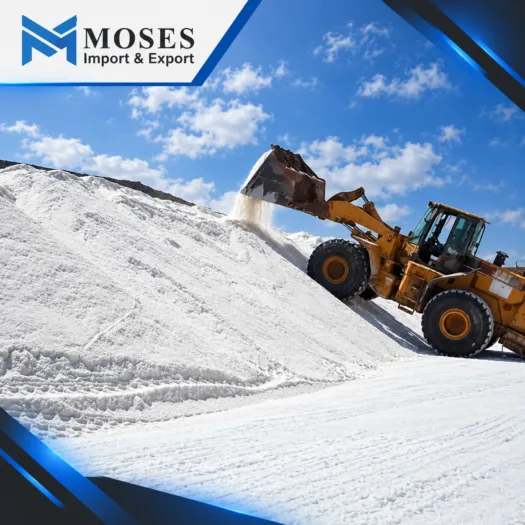
When winter maintenance teams purchase road salt, the real decision is rarely just about finding the cheapest price per ton.
A municipality may need thousands of tons before the first major snow event. A logistics center may care more about reliable delivery and storage. A distributor may need bagged material in consistent grain sizes. An airport or highway contractor may require technical documentation tied to a specific specification.
That is why Rock Salt from Egypt from Siwa should be evaluated as a commercial deicing material rather than simply as “natural salt from Egypt.”
Siwa Oasis in Egypt’s Western Desert is known as a source of natural Rock Salt from Egypt. Moses Salt Co.’s original article positions Siwa salt as an economical sodium chloride option for winter road maintenance and deicing applications.
Its commercial value, however, depends on more than origin.
Purity, grain size, moisture, storage behavior, packaging, shipment volume and landed cost all matter when choosing a road salt supplier.
Table of Contents
What Is Siwa Rock Salt?
Siwa rock salt is naturally occurring sodium chloride obtained from salt deposits in the Siwa region of Egypt.
In geological terms, rock salt is primarily halite, the mineral form of sodium chloride.
After extraction, material intended for commercial use may be crushed, screened and graded so that the particle distribution matches a particular application.
This distinction is important.
Raw salt rock and finished de-icing rock salt are related materials, but they are not necessarily the same commercial product.
A buyer ordering road salt needs to know what happens between extraction and shipment:
| Buyer question | Why it matters |
|---|---|
| What is the NaCl specification? | Helps define the chemical grade |
| What is the moisture level? | Can influence storage and flow |
| What is the particle-size range? | Affects spreading and dissolution |
| Is the salt screened or washed? | Influences consistency and cleanliness |
| What packaging is supplied? | Changes handling and logistics |
| Is a COA available? | Allows the buyer to verify the shipment specification |
Several competing Egyptian suppliers now structure their rock-salt pages around exactly these factors: NaCl content, moisture, particle size, certificates of analysis and export terms.
How Does Rock Salt Melt Ice?
The mechanism is straightforward chemistry.
Sodium chloride dissolves in available water and forms brine. Dissolved salt lowers the freezing point of water, helping prevent ice formation or encouraging existing ice and compacted snow to melt when conditions are suitable.
This is why sodium chloride remains one of the most widely used materials for winter road maintenance.
The U.S. EPA describes rock salt, or sodium chloride, as the most common substance used for road deicing and notes that it is effective and comparatively inexpensive.
But temperature matters.
A sodium chloride solution has a theoretical eutectic temperature of about −21°C, yet this should not be confused with the temperature at which ordinary dry salt remains operationally economical on a road. FHWA guidance notes that many agencies consider conventional salt increasingly slow and impractical for general snow and ice control around pavement temperatures of roughly −9°C to −10°C.
So the useful question is not:
“Does salt work below zero?”
It does.
The better question is:
“At the expected pavement temperature, how quickly will this salt work, and how much material will be required?”

Grain Size Matters in Road Deicing
A ton of salt is not automatically equivalent to another ton of salt.
Particle size changes how the material behaves.
FHWA guidance explains that larger salt particles can penetrate through snow or ice toward the pavement surface, while finer particles have greater surface area and can dissolve more quickly under appropriate conditions.
That creates a practical purchasing decision.
Very fine material may dissolve quickly but behave differently during spreading. Coarser particles can provide penetration and different persistence characteristics.
This is why leading competitors increasingly advertise defined sieve bands rather than simply “coarse road salt.”
For example, current Egyptian supplier pages separate deicing products into different particle-size specifications and regional grades rather than treating all bulk road salt as one product.
For a buyer, “coarse salt” is therefore not a complete specification.
A grain-size range is.
Bulk Deicing Salt: What Should Professional Buyers Compare?
The market for bulk deicing salt is different from the retail market for small bags of ice-melting products.
Large buyers need consistency across hundreds or thousands of tons.
A useful comparison looks like this:
| Specification | Supplier A | Supplier B |
|---|---|---|
| NaCl | ? | ? |
| Moisture | ? | ? |
| Water insolubles | ? | ? |
| Grain range | ? | ? |
| Anti-caking treatment | ? | ? |
| Packaging | ? | ? |
| COA | ? | ? |
| Quantity | ? | ? |
| FOB/CIF/CFR | ? | ? |
| Loading port | ? | ? |
Until these fields match, comparing only the price per metric ton can be misleading.
A quotation for natural-moisture salt in loose bulk is not directly comparable with kiln-dried material supplied in one-ton FIBC bags.
The product may have the same origin but not the same commercial cost structure.
Why Siwa Rock Salt Can Be Economically Interesting
The original Moses article describes Siwa salt as a cost-effective choice because the raw material is naturally abundant and can be extracted for high-volume supply.
That is a reasonable starting point, but “cost-effective” should be measured at the buyer’s destination.
A low ex-works or FOB price can become less attractive once the buyer adds:
freight, loading, packaging, insurance, port charges, unloading, inland transport and storage.
For that reason, the commercial question should be:
What is the landed cost of the required road-salt specification?
not simply:
Which supplier has the lowest salt price?
This is also why competing Egyptian exporters prominently advertise FOB, CFR and CIF supply rather than quoting the commodity in isolation.
Road Salt Supplier: Documentation Matters
For a professional buyer, the relationship with a road salt supplier should begin with specification rather than sales language.
Words such as “premium,” “high purity,” “best quality” and “international standard” are difficult to evaluate without supporting documents.
A more useful purchasing file contains the technical data relevant to the order.
Depending on the transaction, that may include a technical data sheet, certificate of analysis, safety data sheet, grain-size analysis and shipment documents.
Current competitors in the Egyptian export market increasingly emphasize per-lot COA testing, TDS/SDS documentation and third-party inspection as part of their commercial positioning.
That competitive shift is important.
For large-volume buyers, documentation is becoming part of the product.

Egyptian Road Salt for Municipalities and Contractors
The buyers searching for Egyptian road salt are not all the same.
A municipality may buy through a seasonal tender and require a precise specification.
A highway contractor may need repeated deliveries through the winter.
A wholesaler may import one vessel and redistribute the salt locally.
A commercial property operator may purchase much smaller bagged quantities.
The salt source can remain the same while the commercial product changes.
For example, a municipal tender may specify particle distribution and chemical composition, while a distributor may place greater emphasis on bag weight, pallet configuration and warehouse handling.
A strong quotation should reflect those differences.
Road De-Icing Salt vs Raw Rock Salt
There is an important distinction between natural mined material and finished road de-icing salt.
Raw rock salt can contain a range of particle sizes and natural impurities.
A road-grade product may be screened or otherwise prepared to reach an agreed specification.
This does not mean every deicing salt must be highly refined.
For winter roads, excessive refining may add cost without adding practical value.
The goal is not to create the purest salt theoretically possible.
It is to supply a grade that performs reliably in the intended spreading equipment and operating conditions.
That is why specification should follow application.
Fine or Coarse Deicing Salt?
There is no universally superior grain size.
Fine particles can dissolve more rapidly because of their larger relative surface area. Coarse grains can penetrate snow and ice differently and may remain present on the road surface for longer.
FHWA specifically notes this trade-off when discussing gradation for anti-icing and deicing operations.
For a purchasing manager, the right approach is therefore to match particle distribution to:
spreader equipment, local winter conditions, road-maintenance strategy and tender requirements.
This is stronger than ordering “extra coarse” purely because larger grains look more substantial.
Storage Can Change the Usability of Road Salt
Rock salt itself is highly stable, but poor storage can reduce its practical usability.
Moisture can cause salt to cake or form larger masses. Uncovered stockpiles can also lose dissolved salt through runoff.
EPA material on winter road maintenance notes that poorly managed salt-storage facilities can contribute chlorides to surrounding soil and water.
For a bulk buyer, storage planning should happen before the shipment arrives.
A cheap vessel load becomes less economical if part of the stock cakes, washes away or becomes difficult to move through spreading equipment.
The warehouse, stockpile cover, drainage and handling method are therefore part of the procurement decision.

Is Rock Salt Environmentally Friendly?
The original Moses article described Siwa rock salt as offering a balance between effectiveness and environmental friendliness.
That claim needs qualification.
Rock salt is natural, but natural does not mean environmentally neutral.
Road salt can increase chloride concentrations in surface water and groundwater, affect roadside vegetation, contribute to soil changes and accelerate corrosion of vehicles or infrastructure. EPA sources document these impacts.
The better sustainability argument is therefore efficient use, not “eco-friendly salt.”
Good winter maintenance aims to use enough material to achieve the required safety outcome while avoiding unnecessary application.
Proper calibration, weather monitoring, pre-wetting where appropriate, good storage and trained operators can all help reduce unnecessary salt consumption.
Ice Melt Salt: Salt Is One Option, Not Every Option
The phrase ice melt salt is often used broadly in commercial searches.
But different deicers behave differently.
Sodium chloride, calcium chloride and magnesium chloride do not have identical temperature characteristics.
FHWA data shows that calcium chloride and magnesium chloride solutions have lower eutectic temperatures than sodium chloride solutions.
That does not automatically make them better for every situation.
Material price, corrosion potential, application method, temperature, availability and operating procedures all matter.
For ordinary winter road maintenance at moderate sub-zero temperatures, sodium chloride remains widely used because of its combination of availability, familiarity and cost.
Packaging for Bulk Rock Salt
A rock salt supplier may offer several delivery formats.
The correct option depends on how the buyer will unload, store and redistribute the material.
Current Egyptian market offerings include bagged supply, one-ton FIBC or jumbo bags, containerized loads and loose bulk vessel shipments.
A distributor with a warehouse may prefer bags or FIBCs.
A municipality equipped with large salt barns may find loose bulk more efficient.
At this stage, packaging is no longer a cosmetic choice.
It affects labor, unloading, warehouse space and total landed cost.
Buying Rock Salt from Egypt: A Better RFQ
Buyers searching for a bulk salt supplier Egypt often send requests containing only quantity and destination.
That is rarely enough for a meaningful quotation.
A stronger RFQ should include:
- application: deicing, anti-icing or another use;
- required NaCl specification;
- desired grain-size range;
- moisture requirement if applicable;
- total tonnage;
- packaging or loose-bulk requirement;
- destination country and port;
- required Incoterm;
- applicable standard or tender specification;
- required COA, inspection or technical documents.
Those ten lines can prevent weeks of comparing quotations for products that were never equivalent in the first place.
Send your rock salt requirements to info@mosesexport.com.
FOB, CFR or CIF?
International bulk road salt offers are commonly quoted under different Incoterms.
The difference matters.
An FOB quotation generally stops at the agreed loading point under the applicable Incoterm responsibilities.
CFR adds ocean freight to the named destination port.
CIF also includes insurance under the relevant Incoterm structure.
Current Egyptian competitors prominently offer FOB, CFR and CIF structures for bulk deicing salt shipments.
Therefore, never rank two salt quotations by the headline price without checking the term next to it.
What Makes a Reliable Deicing Salt Supplier?
A professional deicing salt supplier should make it easy to answer three questions:
What exactly am I buying?
Can you supply the volume consistently?
Can you document what you ship?
Price comes after those questions, not before them.
A dependable supplier relationship is especially important in winter procurement because replacing a failed or off-spec shipment after severe weather begins may be much harder than resolving the problem in summer.
Competitor pages targeting municipal and highway buyers increasingly emphasize seasonal availability, defined grades, shipment-specific testing and logistics planning for exactly this reason.
Siwa Rock Salt and the European Market
European road-salt buyers may have requirements linked to defined grading, contractual technical specifications or standards such as EN 16811-1.
Some competing Egyptian exporters now explicitly market road-salt grades around that standard.
That does not mean every shipment of Siwa rock salt automatically conforms to a European standard.
Compliance should be confirmed for the actual product being quoted and supported by the appropriate documentation.
This distinction is important:
origin is not compliance.
A material can come from Siwa and still require processing, grading and verification before it matches a particular buyer specification.
Siwa Rock Salt for the USA and Canada
North American buyers can have different specifications.
Competitor pages targeting the U.S. and Canadian markets advertise Egyptian rock salt according to ASTM D632-related grades and specific particle-size ranges.
Again, the useful lesson is not that one standard is universally required.
It is that exporters should sell against the destination specification rather than assuming the same road salt fits every market.
For an international rock salt supplier, market-specific preparation is a stronger commercial advantage than simply offering one generic coarse salt.
Egyptian Rock Salt: Buy the Specification, Not the Story
Siwa gives Egyptian rock salt a recognizable origin.
But origin alone does not melt ice, fit a spreader or satisfy a municipal tender.
The commercial value comes from the complete product:
NaCl specification + particle size + moisture + preparation + documentation + packaging + logistics + delivered cost.
That is the level at which professional buyers should compare a road salt supplier, a rock salt supplier or any exporter offering bulk deicing salt.
Siwa rock salt can be a practical and economically attractive deicing material.
The strongest purchasing decision, however, is not:
“Is this Siwa Rock Salt?”
It is:
“Does this Siwa rock salt meet the exact winter-maintenance specification I need, at a competitive landed cost?”