
Salt Producers Around the World: A Complete Directory of Salt Companies by Country (2026)
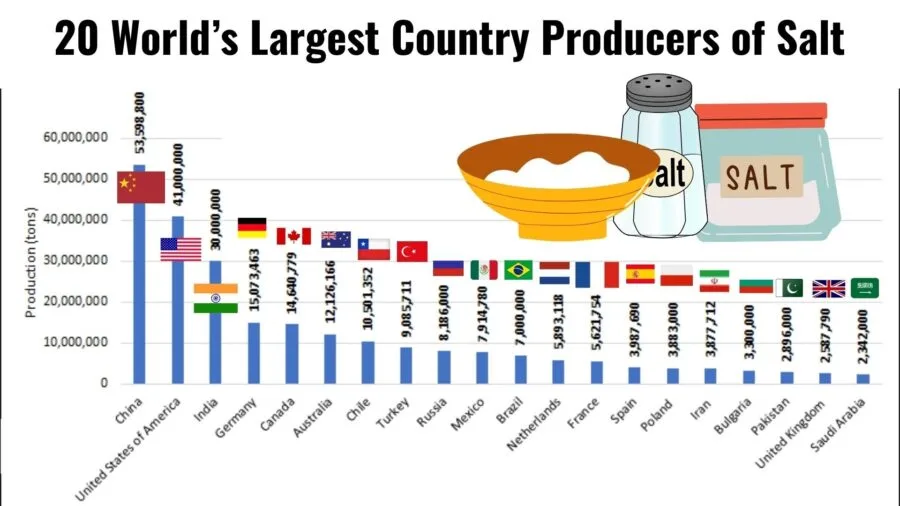
Global salt production reached an estimated 270 million tonnes in 2025, according to the US Geological Survey (USGS). China, the United States and India remain the world’s leading salt-producing countries, supported by a global industry that includes major mining groups, solar salt producers, vacuum salt manufacturers and industrial salt processors.
A relatively small number of major companies account for a significant share of global salt production. These include China National Salt Industry Group, Morton Salt, Compass Minerals, Cargill, K+S, Tata Chemicals, Nobian, Groupe Salins and Rio Tinto’s Dampier Salt.
This comprehensive guide covers more than 120 salt producers across over 60 countries. Organized by region, it provides an overview of leading salt companies, their ownership, production methods and major operating sites.
Compiled and maintained by ZOUTMAN, a Belgian sea salt producer, this directory draws on information from the US Geological Survey, EuSalt and company publications. The latest revision is dated October 2026.
Table of Contents
Global Salt Production at a Glance (2025)
According to the US Geological Survey’s Mineral Commodity Summaries 2026, worldwide salt production was estimated at 270 million tonnes in 2025, compared with 275 million tonnes in 2024.
China, the United States and India together account for almost half of global production. Europe is the world’s second-largest salt-producing region after Asia, generating approximately 50 million tonnes annually, according to EuSalt, the association representing European salt producers.
Salt Production by Country
The following table presents estimated salt production volumes for 2025 alongside 2024 figures and the main sources of salt in each country.
| Rank | Country | 2024 Production (Million Tonnes) | 2025 Estimate (Million Tonnes) | Main Salt Sources |
|---|---|---|---|---|
| 1 | China | 56.0 | 56.0 | Rock salt, well brine, lake salt and sea salt |
| 2 | United States | 40.4 | 40.0 | Brine (44%), rock salt (38%), solar and vacuum salt |
| 3 | India | 34.0 | 30.0 | Solar sea salt, particularly in Gujarat and Tamil Nadu, and lake salt in Rajasthan |
| 4 | Germany | 15.0 | 15.0 | Rock salt mining and vacuum salt production |
| 5 | Canada | 10.6 | 13.0 | Rock salt from Goderich, Windsor and Pugwash |
| 6 | Australia | 12.0 | 12.0 | Solar sea salt from the Pilbara region and Shark Bay |
| 7 | Chile | 8.9 | 9.0 | Salt extracted from the Salar Grande salt flats |
| 8 | Turkey | 8.4 | 8.3 | Lake Tuz salt and rock salt |
| 9 | Mexico | 7.0 | 7.0 | Solar sea salt from Guerrero Negro and Yucatán, plus vacuum salt |
| 10 | Russia | 6.9 | 7.0 | Rock salt, lake salt and vacuum salt |
| 11 | Brazil | 6.6 | 6.6 | Solar sea salt, mainly from Rio Grande do Norte |
| 12 | Netherlands | 5.8 | 5.4 | Vacuum salt produced from solution-mined brine |
| 13 | France | 4.5 | 4.5 | Sea salt, rock salt and vacuum salt |
| 14 | Iran | 4.2 | 4.2 | Rock salt |
| 15 | Poland | 3.4 | 4.1 | Vacuum salt and rock salt |
| 16 | Spain | 4.0 | 4.0 | Solar sea salt, rock salt and vacuum salt |
| 17 | Pakistan | 3.1 | 3.1 | Rock salt from Khewra and sea salt |
| 18 | Bulgaria | 2.6 | 2.7 | Brine for soda ash production and sea salt |
| 19 | United Kingdom | 2.6 | 2.6 | Rock salt from Winsford and Kilroot, plus vacuum salt |
| 20 | Saudi Arabia | 2.4 | 2.4 | Solar salt |
| 21 | Egypt | 2.3 | 2.3 | Solar sea salt |
| 22 | Belarus | 2.0 | 2.0 | Vacuum salt |
| 23 | Italy | 3.0 | 1.9 | Rock salt from Sicily and sea salt |
| — | Other countries | 29.0 | 28.0 | Various sources |
| — | Worldwide total | 275 | 270 | — |
Source: USGS Mineral Commodity Summaries 2026, published in February 2026. Figures for 2025 are estimates.
Belgium is not included in the production table because it has no natural salt deposits. Belgian companies, including ZOUTMAN, process crude sea salt harvested from solar saltworks in other countries. Further details are provided in the methodology section.
What Is Salt Mainly Used For?
Salt is an essential raw material for many industries, and most of the world’s production is used for purposes other than household food consumption.
In the United States, the chemical industry accounts for approximately 42% of salt sales, primarily for manufacturing chlorine, caustic soda and soda ash. Road de-icing represents another 37%, while food processing, water treatment, agriculture and other industrial applications account for the remainder, according to USGS 2026 data.
The European sea salt market has a different distribution of end uses. According to EuSalt’s 2023 data, the sector is divided among food production (29%), de-icing (22%), agriculture (13%), retail (12%), chlor-alkali production (8%) and water treatment (7%).
Source: EuSalt Sea Salt Market Brochure.
The Four Main Types of Salt Producers
Salt producers differ significantly in their extraction methods, processing technologies and target markets. Understanding these differences helps buyers identify suitable suppliers based on salt purity, grain size, intended application and production capacity.
1. Rock Salt Mining Companies
Rock salt, also known as halite, is extracted from underground deposits formed by ancient bodies of water that evaporated over geological time. After extraction, the salt is crushed, screened and prepared for its intended application.
Rock salt is widely used for road de-icing and various industrial purposes.
Major examples include Compass Minerals’ Goderich mine in Canada, recognized as the world’s largest underground salt mine; K+S operations at Bernburg and Borth in Germany; Südwestdeutsche Salzwerke’s Heilbronn mine; Compass Minerals’ Winsford mine in England; Groupe Salins’ Varangéville mine in France; and the Khewra mine in Pakistan.
2. Solution Mining and Vacuum Salt Manufacturers
Solution mining involves injecting water into underground salt deposits to dissolve the salt and produce brine, which is then pumped to the surface. This brine can be supplied directly to chemical manufacturers or processed further to produce crystallized salt.
In vacuum salt production, the brine is crystallized using multiple-effect vacuum evaporation systems. The process produces high-purity salt, typically containing 99.9% sodium chloride (NaCl).
Vacuum salt is an important raw material for table salt, water-softening salt and pharmaceutical applications, particularly in north-western Europe.
Leading companies operating in this segment include Nobian, K+S, British Salt, Südwestdeutsche Salzwerke, Salinen Austria, Schweizer Salinen, Qemetica, Cargill and Morton Salt.
3. Solar Sea Salt and Lake Salt Producers
Solar salt producers use sunlight and wind to evaporate seawater or natural lake brine. The water passes through a series of shallow evaporation ponds, allowing salt crystals to form before harvesting.
This production method is widely used in Australia, Mexico, India, Brazil, Turkey, Egypt and Mediterranean countries. It is also the source of the crude sea salt processed by ZOUTMAN.
Representative producers include Exportadora de Sal in Mexico, Dampier Salt and Mitsui’s Shark Bay Salt in Australia, Groupe Salins in France, Spain and Italy, Hellenic Saltworks in Greece, Koyuncu in Turkey, Walvis Bay Salt in Namibia and Salinor in Brazil.
According to EuSalt, sea salt represents approximately 10% of European salt production, equivalent to around 3.4 million tonnes annually from approximately 48 companies.
4. Salt Refining and Processing Companies
Salt refiners and processors purchase crude solar salt or mined rock salt and transform it into products suited to specific markets. Processing operations may include washing, drying, screening, iodization, compaction into tablets or blocks, and packaging.
Their finished products serve food manufacturers, water-treatment businesses, animal-feed producers, pharmaceutical companies and road-maintenance operators.
In countries without significant natural salt deposits, processing companies play a central role in supplying domestic demand. Examples include Belgium, Japan, South Korea, Nigeria and several Scandinavian markets.
Notable companies in this category include ZOUTMAN in Belgium, Cerebos in South Africa, NASCON/Dangote Salt in Nigeria, Hanju in South Korea, Taiyen in Taiwan and Peacock Salt in Scotland.
The World’s Largest Salt Companies
The global salt industry does not have a single company controlling the entire market. Instead, production and supply are distributed among major multinational groups and established regional manufacturers.
The companies below are among the industry’s most significant players, based on their reported scale, geographical reach, production facilities and market presence.
| Company and Headquarters | Ownership | Main Production Types | Key Operations and Scale |
|---|---|---|---|
| China National Salt Industry Group — Beijing, China | Chinese state-owned, under SASAC | Rock, lake, sea and vacuum salt | A nationwide group with subsidiaries across China, generally regarded as the world’s largest salt company by volume. |
| SCIH Salt Holdings — Morton Salt — Overland Park, Kansas, USA | Privately owned by Stone Canyon Industries Holdings | Rock, vacuum and solar salt | Includes Morton Salt, Windsor Salt, SPL in Chile, Kissner, Detroit Salt and Morton Bahamas. Acquired from K+S in 2021 for US$3.2 billion; one of the largest salt groups in the Americas. |
| Compass Minerals — Overland Park, Kansas, USA | Publicly listed, NYSE: CMP | Rock and solar salt | Operates mines at Goderich, Cote Blanche and Lyons, solar saltworks at Great Salt Lake, and the Winsford mine in the UK. Reported 10.8 million tonnes of salt sold in fiscal 2025. |
| Cargill Salt — Minnesota, USA | Privately owned by Cargill | Rock, vacuum and solar salt | Operations include rock salt mines beneath Lake Erie and at Lansing, an evaporated salt plant in Breaux Bridge, and solar salt production in California and Bonaire. |
| K+S — Kassel, Germany | Publicly listed, K+S AG | Rock and vacuum salt | Major European producer with operations in Germany, the Netherlands and France. Agreed to acquire Qemetica’s Staßfurt and Janikowo plants, with completion expected in 2027. |
| Nobian — Amersfoort, Netherlands | Carlyle and GIC | Vacuum salt | Produces approximately 6 million tonnes of high-purity vacuum salt annually, with operations in the Netherlands, Germany and Denmark. Previously part of AkzoNobel Salt. |
| Tata Chemicals — Mumbai, India | Tata Group, publicly listed | Solar sea salt and vacuum salt | Operates the Mithapur complex in Gujarat, with approximately 1.6 million tonnes of annual production, and owns British Salt in the UK. Tata Salt is a leading Indian consumer brand. |
| Dampier Salt — Perth, Australia | Rio Tinto 68%, Marubeni 22%, Sojitz 10% | Solar sea salt | Operates at Dampier and Port Hedland in the Pilbara region and is one of the world’s major exporters of seaborne salt. Lake MacLeod was sold to Leichhardt Industrials in 2024. |
| Exportadora de Sal (ESSA) — Guerrero Negro, Mexico | Mexican state-owned, 100% since 2024 | Solar sea salt | Operates one of the world’s largest solar saltworks, with approximately 8 million tonnes of annual production capacity across around 780 km² of evaporation ponds. |
| Mitsui & Co. — Tokyo, Japan | Publicly listed | Solar sea salt | Owns interests in Shark Bay Salt, which supplies food-grade salt, and Onslow Salt, which produces approximately 2.5 million tonnes of industrial salt annually in Western Australia. |
| Groupe Salins — Clichy, France | Privately owned by Finachef | Sea, rock and vacuum salt | Has approximately 4 million tonnes of capacity across 15 sites, including operations in France, Spain, Italy and Tunisia. Its brands include La Baleine, JOZO and NEZO. |
| Südwestdeutsche Salzwerke — Heilbronn, Germany | Publicly owned by the State of Baden-Württemberg and the City of Heilbronn | Rock and vacuum salt | Operates the Heilbronn mine, described as the largest salt mine in Western Europe, along with additional German facilities and the Bad Reichenhaller brand. Employs approximately 1,100 people. |
Other significant regional producers include Qemetica in Poland, Nirma and Archean Chemical Industries in India, Koyuncu and Mutlucan in Turkey, Araltuz in Kazakhstan, Hellenic Saltworks in Greece, Italkali in Italy, Walvis Bay Salt in Namibia, Salinor in Brazil and Quimpac in Peru. These companies are covered in the regional directory below.
Salt Producers in Europe: Leading Salt Companies by Country
Europe produces approximately 50 million tonnes of salt annually. Around 90% of this output comes from underground rock-salt mining and solution-mined vacuum salt, particularly in Germany, the Netherlands, Poland, France and the United Kingdom. The remaining 10% is mainly sea salt harvested along the Mediterranean and Atlantic coasts, according to EuSalt. Its members account for more than 80% of European salt production.
Belgium
- ZOUTMAN — Based in Roeselare and North Sea Port Ghent, ZOUTMAN is an independent family-owned company founded in 1997. It processes crude solar sea salt through washing, drying, screening and packaging for food applications under MARSEL®, water softening under SOFT-SEL®, de-icing, agriculture and swimming pools. The company ships approximately 300,000–450,000 tonnes annually to more than 60 countries. As Belgium has no natural salt deposits, its salt industry relies on sea salt harvested at solar saltworks abroad. Official website
Netherlands
- Nobian — A major European producer of industrial and vacuum salt, with production facilities in the Netherlands and other European markets. Its salt supports industrial applications, including the chemical industry, as well as water treatment and other uses. Official website
Germany
- K+S — Headquartered in Kassel, K+S is one of Europe’s leading salt producers. Its operations include rock-salt mines and vacuum-salt facilities at Bernburg, Borth, Braunschweig-Lüneburg and Grasleben, alongside sites in Harlingen in the Netherlands and Dombasle in France. Its products serve de-icing, industrial, food and pharmaceutical markets. In June 2026, K+S agreed to acquire Qemetica’s evaporated-salt facilities in Staßfurt and Janikowo, with completion expected in early 2027. Official website
- Südwestdeutsche Salzwerke (SWS) — Based in Heilbronn, SWS operates the Heilbronn mine, described as the largest rock-salt mine in Western Europe. Its operations also include evaporated-salt facilities at Bad Friedrichshall, Bad Reichenhall and Berchtesgaden. The Bad Reichenhaller brand is part of its portfolio, and the company employs approximately 1,100 people. Official website
- Nobian Germany — Nobian’s German operations include its vacuum-salt plant in Frankfurt-Höchst. Official website
- Qemetica Salz Deutschland — Based in Staßfurt, the company produces evaporated salt for food and water-softening applications. Its salt business is being acquired by K+S. Company information
France
- Groupe Salins — Also known as Compagnie des Salins du Midi et des Salines de l’Est, Groupe Salins is headquartered in Clichy and is a major player in the French salt industry. The group has approximately 4 million tonnes of capacity across 15 sites. Its operations include sea-salt production at Aigues-Mortes and Salin-de-Giraud in the Camargue, the Varangéville rock-salt mine in Lorraine, and evaporated-salt production at Dax and Einville. Its best-known brand includes La Baleine. The group also owns salt operations in Spain, Italy and Tunisia. Official website
- esco France / K+S France — Based in Dombasle-sur-Meurthe, this producer manufactures around 200,000 tonnes of vacuum salt annually, including pharmaceutical grades and AXAL water-softening tablets. It is also associated with the Cérébos table-salt brand. K+S website
- Les Salines de Guérande — Le Guérandais — This cooperative in Guérande represents salt workers who harvest traditional grey sea salt and fleur de sel by hand. Official website
- Coopérative des Sauniers de l’Île de Ré — Based in Ars-en-Ré, this cooperative produces the protected Sel de l’Île de Ré and Fleur de sel de l’Île de Ré products.
United Kingdom and Ireland
- Compass Minerals UK — Located in Winsford, Cheshire, this company operates Britain’s largest and oldest working rock-salt mine. Its main market is de-icing salt, and it belongs to the US-based Compass Minerals group. UK website
- British Salt (Tata Chemicals Europe) — Based in Middlewich, Cheshire, British Salt is the UK’s leading vacuum-salt producer. It has been fully owned by India’s Tata Chemicals since 2010. Official website
- Irish Salt Mining & Exploration — Operating from Kilroot near Carrickfergus in Northern Ireland, the company runs Northern Ireland’s only salt mine and produces approximately 500,000 tonnes of de-icing rock salt each year. Official website
- Maldon Salt — This family-owned Essex company has produced its distinctive pyramid-shaped sea-salt flakes since 1882. Official website
- Cornish Sea Salt Co. — Produces sea salt harvested from Cornish seawater, with operations dating back to 2008. Official website
- Halen Môn — Anglesey Sea Salt — Based on Anglesey in Wales, Halen Môn produces sea salt from the Menai Strait under protected designation of origin (PDO) status. Official website
- Peacock Salt — Located in Ayr, Scotland, Peacock Salt mainly processes and distributes salt rather than extracting it directly. Official website
- Republic of Ireland — Ireland has no large-scale industrial salt production. Smaller sea-salt producers include Achill Island Sea Salt and Oriel Sea Salt.
Spain and Portugal
- Salinas de Torrevieja (Groupe Salins) — Located in Torrevieja, Alicante, this is one of Europe’s largest solar saltworks. It harvests salt from the Torrevieja and La Mata lagoons, with production expected to reach around 500,000 tonnes in 2026. Its output serves de-icing, industrial and food markets. Groupe Salins
- Infosa — Industrias de la Sal — Based at the Salinas de la Trinidad in the Ebro Delta, Tarragona, Infosa harvests sea salt within the delta’s protected natural area. Official website
- ICL Iberia — Operating in Súria, Catalonia, ICL Iberia produces vacuum salt using brine from its mining operations. Official website
- Salinera Española — Based in Ibiza, the company harvests approximately 50,000–65,000 tonnes of sea salt annually from the historic Ses Salines salt pans on Ibiza and Formentera.
- Portugal — Portuguese salt production is largely based on traditional solar sea-salt harvesting and flor de sal. Key locations include the Aveiro lagoon, Figueira da Foz and the Algarve, particularly Castro Marim and Tavira. The country has no major industrial salt producer comparable to Europe’s largest groups.
Italy
- Italkali — Headquartered in Palermo, Italkali mines rock salt in Sicily. Its Petralia, Racalmuto and Realmonte mines produce more than 1 million tonnes annually, with exports handled through the Porto Empedocle shipping terminal. Official website
- Compagnia Italiana Sali (Groupe Salins) — Based in Margherita di Savoia, Puglia, the company operates one of Europe’s largest sea-salt facilities, with output of around 700,000 tonnes, as well as the Sant’Antioco site in Sardinia. It took over the former Atisale concessions in 2019. Groupe Salins
- Sosalt — Based in Trapani, Sosalt is a major Italian-owned sea-salt producer operating the historic salt pans of Trapani and Paceco. Official website
Switzerland and Austria
- Schweizer Salinen / Salines Suisses — Based in Pratteln, Schweizer Salinen is Switzerland’s sole salt producer and is owned by the country’s cantons. Its vacuum-salt operations include Schweizerhalle, Riburg and Bex, with products marketed under names such as JuraSel and Sel des Alpes. The company was formed in 2014 through the merger of Rheinsalinen and Saline de Bex. Official website
- Salinen Austria — Based in Ebensee, the company produces salt by evaporating Alpine brine. Its Bad Ischler brand is distributed through subsidiaries across Central Europe. Official website
Poland
- Qemetica (formerly Ciech) — Janikowo / Solino — Based in Warsaw, Qemetica produces evaporated salt at Janikowo using brine from Inowrocław. In June 2026, the company agreed to sell its salt business to K+S, with completion expected in early 2027. Company information
- Kopalnia Soli “Kłodawa” — Located in Kłodawa, this is Poland’s principal operating rock-salt mine. Its products include natural pink rock salt for food, animal feed, de-icing and industrial applications. Official website
- Kopalnia Soli “Wieliczka” — This UNESCO World Heritage mine is now mainly a visitor attraction, although it continues to produce small quantities of evaporated salt from brine. Official website
Romania
- Salrom — Societatea Națională a Sării — Romania’s state-owned salt company operates rock-salt mines at Ocnele Mari, Slănic Prahova, Ocna Dej, Târgu Ocna, Cacica and Ocna Mureș. The Praid mine has been out of operation since flooding in May 2025. Official website
Greece
- Hellenic Saltworks — This state-controlled company operates seven active solar saltworks, including the facility at Messolonghi. It has annual capacity of approximately 230,000 tonnes and accounts for more than 90% of Greek salt production. A majority stake entered the privatisation process during 2025–2026. Official website
- Dadakarides Salt — A salt refiner and packer operating in northern Greece.
- Kalas — A Greek brand specialising in iodised sea salt. Official website
Croatia, Slovenia, Bosnia and Herzegovina, and Bulgaria
- Solana Pag, Solana Nin and Solana Ston — Croatia’s three Adriatic solar saltworks. Pag is the country’s largest producer, while Nin and Ston are known for their historic and traditional salt pans.
- Soline — Piranske Soline — Based in Slovenia, the company produces traditional sea salt and fleur de sel from the Sečovlje and Strunjan salt pans.
- Solana Tuzla — Located in Tuzla, Bosnia and Herzegovina, this historic vacuum-salt producer manufactures food salt and water-softening tablets. Official website
- Bulgaria — Much of the country’s reported 2.7 million tonnes of salt production comes from solution-mined brine at the Mirovo deposit near Provadia, which supplies the Devnya soda-ash industry. Sea salt is also harvested at the Burgas and Pomorie salt pans.
Denmark and Iceland
- Nobian Mariager (formerly Dansk Salt) — Based in Mariager, Denmark, the company produces vacuum salt from solution-mined deposits and is part of Nobian. Official website
- Læsø Salt — This Danish artisan producer makes sea salt by boiling brine using traditional methods associated with the island’s medieval salt-making history.
- Saltverk — Located in Iceland’s Westfjords, Saltverk produces flaky sea salt using geothermal energy. Official website
Belarus, Ukraine and Russia
- Mozyrsalt — Based in Mozyr, Belarus, this state-owned company produces vacuum salt. It was placed on Poland’s sanctions list in 2024. Official website
- Artemsil (Artyomsol) — Located in Soledar, Ukraine, Artemsil previously supplied around 70% of Ukraine’s salt from its rock-salt mines. Production stopped in June 2022, and the site is in occupied territory.
- Drohobych Saltworks — Located in Drohobych, Ukraine, this historic operation has produced salt by boiling brine for more than 600 years. The state-owned business has been slated for privatisation. Other Ukrainian producers include Kation Invest, associated with rock salt in Tereblia, Zakarpattia, and the Chornomorsk salt plant near Odesa.
- Russol — Russia’s largest salt group, with operations covering Iletsk rock salt, Baskunchak lake salt and Usolye-Sibirskoye vacuum salt.
- Tyretsky Salt Mine — Located in Russia’s Irkutsk region, this Siberian rock-salt mine produces approximately 500,000 tonnes annually.
Salt Producers in Turkey, the Middle East and Central Asia
Turkey is one of the world’s leading salt-producing countries, with estimated output of 8.3 million tonnes in 2025, according to the USGS. Lake Tuz is particularly important, accounting for approximately 70% of Turkish salt production. Other major operations across the wider region draw on the Dead Sea, Gulf coast resources and the salt deposits of Central Asia.
Turkey
- Koyuncu Tuz (Koyuncu Group) — Based in Konya, Koyuncu is described as Turkey’s largest salt producer. It harvests salt at the Kaldırım saltworks on Lake Tuz and refines around 400,000 tonnes annually, exporting to more than 50 countries. Official website
- Mutlucan Tuz — Based in Ankara, Mutlucan produces lake salt from Şereflikoçhisar on Lake Tuz and rock salt from Mucur in Kırşehir. Its brands include Mutlucan, Parla and Ahu. Official website
- Salina Tuz — A table-salt processing brand established in 1983. Official website
- Saray Tuz — A producer of natural and refined salt. Official website
- Other producers operating in Turkey’s Lake Tuz and rock-salt regions include Billur Tuz, Cihanbeyli Tuz, Estuz and Yıldırım Tuz.
Israel and Jordan
- Salt of the Earth — Formerly known as Israel Salt Industries, this family-owned producer has operated since 1922. Based in Atlit, Israel, it harvests solar sea salt at Eilat on the Red Sea and at Atlit on the Mediterranean coast. Official website
- ICL Dead Sea Works — Based in Sdom, Israel, this operation focuses on Dead Sea minerals such as potash, bromine and magnesium, with salt generated as a by-product. ICL Group
- Arab Potash Company — Located at Ghor Al Safi in Jordan, the company produces potash from the Dead Sea. Its Numeira subsidiary manufactures Dead Sea salts and mud. Official website
Gulf States and Iran
- Sama Salt Production Company — Based in Abu Dhabi, UAE, Sama Salt produces solar sea salt. The source reports annual output above 250,000 tonnes, with plans to exceed 2 million tonnes. Its product grades serve industrial, drilling and animal-feed markets. Official website
- Saudi Arabia — The country produced an estimated 2.4 million tonnes of salt in 2025, according to the USGS. Production is largely based on solar salt from coastal and inland operations.
- Iran — Annual salt production is estimated at approximately 4.2 million tonnes, mainly from rock-salt deposits in Garmsar and Semnan. International trade is constrained by sanctions.
Kazakhstan
- Araltuz — Located in the Aral district of Kazakhstan’s Kyzylorda region, Araltuz is described as Central Asia’s largest lake-salt producer. It harvests salt from Lake Zhaksykylysh, whose reserves are reported at 47 million tonnes, and produces approximately 850,000 tonnes annually. A 120,000-tonne vacuum-salt plant is planned for 2027. Official website
Salt Producers in Asia-Pacific
Asia-Pacific is a major centre of global salt production. China, India and Australia together produce close to 100 million tonnes annually, while Japan, South Korea, Taiwan and Indonesia are among the region’s major importers of industrial salt.
China
- China National Salt Industry Group (China Salt, CNSG) — Headquartered in Beijing, this state-owned group operates through subsidiaries across China and is generally regarded as the world’s largest salt company by volume. Official website
- Jiangsu Suyan Jingshen — A Shanghai-listed producer of vacuum salt and soda ash associated with Jiangsu Salt Industry Group.
- Shandong Haihua — Based in Weifang, Shandong, this listed brine-chemicals group produces salt, soda ash and bromine from local brine fields.
- Production statistics note: Chinese national figures report substantially higher salt output than the USGS estimate of 56 million tonnes, partly because the national figures include brine used directly by the chemical industry.
India
- Tata Chemicals — Headquartered in Mumbai, Tata Chemicals is India’s leading branded salt producer, known for Tata Salt. Its Mithapur complex in Gujarat produces approximately 1.6 million tonnes annually, while a 210,000-tonne vacuum-salt plant is planned in Tamil Nadu. The company also owns British Salt in the United Kingdom. Official website
- Archean Chemical Industries — Based in Chennai, this listed marine-chemicals company harvests solar salt and bromine in the Rann of Kutch and is a leading Indian exporter of industrial salt. Official website
- Nirma — Headquartered in Ahmedabad, Nirma operates large solar saltworks in Gujarat. Its salt supplies its soda-ash facilities and supports the Shudh edible-salt brand. Official website
- GHCL — A soda-ash producer with captive solar saltworks in Gujarat and Tamil Nadu. It also markets retail salt under the i-FLO brand. Official website
- Dev Salt — Based in Morbi, Gujarat, Dev Salt operates solar saltworks covering approximately 3,700 hectares. The source reports annual production of around 1.2 million tonnes of industrial salt and bromine for the chlor-alkali industry. Official website
- Krishna Salts — Operating in Gujarat and Odisha, Krishna Salts runs solar saltworks and six refineries producing edible and industrial salt for export. Official website
- Hindustan Salts / Sambhar Salts — Based in Jaipur, this government-owned producer operates at Sambhar Lake in Rajasthan, although its current scale is relatively small. Official website
- Chowgule — The Goa-based group has an industrial solar-salt division. Official website
- Ahir Salt Industries — Based in Kutch, Ahir Salt operates solar-powered saltworks and exports food-grade salt to international markets. Official website
- Saboo Sodium Chloro (Surya Salt) — Based in Jaipur, the company is identified in the source as northern India’s largest salt refinery, operating as a processor. Official website
Pakistan
- Pakistan Mineral Development Corporation (PMDC) — Headquartered in Islamabad, PMDC is a state-owned mining company operating the Khewra, Warcha and Kalabagh salt mines. Khewra is commonly described as the world’s second-largest salt mine, and Khewra Pink Rock Salt received geographical-indication status in 2022. Pakistan exported approximately 148,000 tonnes of pink salt in fiscal year 2026. Official website
- Hub-Pak Salt Refinery — Based in Karachi, Hub-Pak is a major sea-salt refiner and exporter. It operates seven plants near Karachi and serves customers in more than 30 countries. Official website
Japan, South Korea and Taiwan
- Japan — Japan has no natural salt deposits and imports most of its annual demand of approximately 8 million tonnes, mainly from Mexico and Australia. Domestic producers refine salt by concentrating seawater using ion-exchange membranes, under the oversight of the Salt Industry Center of Japan.
- Hanju Corporation — Based in Ulsan, South Korea, Hanju is the country’s only refined-salt manufacturer. Traditional solar sea salt is also harvested on the Shinan islands in the south-west.
- Taiyen Biotech (Taiwan Salt Industrial Corporation) — Based in Tainan, Taiwan, this former state salt monopoly is now a listed consumer-goods company that continues to refine imported salt. Official website
South-East Asia
- PT Garam — Indonesia’s state-owned salt company produces approximately 500,000 tonnes annually. It plans to develop a 1-million-tonne industrial-salt plant with Pertamina in Balikpapan, while Indonesia continues to import around 64% of its salt requirements. Official website
- Cheetham Garam Indonesia — The Indonesian operation of CK Life Sciences’ salt group, which also operates in Australia and New Zealand.
- Pimai Salt — Based in Nakhon Ratchasima, Thailand, Pimai Salt is a major Thai producer that uses solution mining to extract rock salt from the Khorat Plateau.
- Visalco (Vietnam Salt Company) — Operates in Vietnam, where salt production still largely depends on small-scale solar evaporation along the coast.
Australia and New Zealand
- Dampier Salt — Owned by Rio Tinto (68%), Marubeni (22%) and Sojitz (10%), Dampier Salt operates solar saltworks at Dampier and Port Hedland in Western Australia’s Pilbara region. It is one of the world’s major exporters of seaborne salt. Lake MacLeod, which produced around 1.5 million tonnes annually, was sold to Leichhardt Industrials in December 2024. Rio Tinto
- Mitsui & Co. — Shark Bay Salt and Onslow Salt — Mitsui’s Western Australian operations produce food-grade solar salt at Useless Loop in Shark Bay and approximately 2.5 million tonnes of industrial salt annually at Onslow, primarily for Asian markets. Mitsui & Co.
- Leichhardt Industrials Group — Since 2024, Leichhardt has owned the Lake MacLeod solar-salt and gypsum operation and has also been developing the Eramurra salt project.
- Cheetham Salt (CK Life Sciences) — Founded in 1888, Cheetham Salt is described as Australia’s largest salt-products producer. Its operations include lake- and sea-salt works and refineries across the country. Related businesses include Dominion Salt in New Zealand and Cheetham Garam Indonesia. Official website
- BCI Minerals — Mardie Salt & Potash — Located in the Pilbara, the Mardie project is a large-scale solar salt development. The source states that first salt exports are expected in late 2026. Official website
- WA Salt Group — A Western Australian producer of lake salt, including salt from Lake Deborah.
- Dominion Salt — Based at Lake Grassmere in Marlborough, New Zealand, Dominion Salt is the country’s only salt producer. It harvests solar salt at Lake Grassmere and operates a refinery at Mount Maunganui. The company is part of CK Life Sciences’ salt group. Official website
Salt Producers in Africa
Egypt is identified as Africa’s leading salt producer, with output estimated at 2.3 million tonnes according to the USGS 2026 figures cited in the source. The continent also has significant solar salt operations in Namibia, Tunisia, Senegal and Botswana. In Nigeria, the industry relies heavily on refining imported raw salt.
Egypt
- El Nasr Salines Company — A state-owned sea-salt producer based in Alexandria. Its operations include saltworks at El Max and Borg El Arab near Alexandria, as well as El Arish in North Sinai.
- EMISAL — Egyptian Salts & Minerals Company — Based in Fayoum, EMISAL produces salt and sodium sulphate using brine from Lake Qarun.
- Egyptian Company for Salt Refining (Egypt Salt) — Based in 10th of Ramadan City, this private refiner and exporter sources salt from operations in North Sinai, Damietta and Siwa. According to the source, Egyptian salt exports reached a record value of approximately US$77 million during the first ten months of 2025.
- Moses Salt Company for export egyptian salt based in damietta mail elsaied the factory in alexandriea Egyptian salt exports reached a record value of approximately US$66 million during the first ten months of 2025
Tunisia, Algeria and Morocco
- COTUSAL — Compagnie Générale des Salines de Tunisie — Headquartered in Tunis, COTUSAL is Tunisia’s leading sea-salt producer. Its operations include Sfax-Thyna, Sahline, Sousse and Zarzis. The company is majority-owned by Groupe Salins, and exports account for around two-thirds of its revenue.
- ENASEL — Entreprise Nationale du Sel — Based in Constantine, Algeria, this state-owned salt company mines rock salt at El Outaya and harvests salt from the country’s salt lakes.
- Société de Sel de Mohammedia (Delta Holding) — Located in Mohammedia, Morocco, the company is described as Morocco’s largest salt producer. It has rock-salt capacity of around 1 million tonnes and exports up to 700,000 tonnes annually for de-icing markets in Europe and North America.
West Africa
- Les Salins du Sine Saloum — Based in Kaolack, Senegal, the company is a major sea-salt exporter serving markets including Mali, Burkina Faso, Côte d’Ivoire and Guinea. It has been Senegalese-owned since privatisation.
- Electrochem Ghana (McDan Group) — The company has been developing solar saltworks at the Ada Songor lagoon in Ghana since 2022. Its stated target exceeds 2 million tonnes annually, which would make the operation one of West Africa’s largest.
- NASCON Allied Industries (Dangote Salt) — Based in Lagos, Nigeria, NASCON is a leading salt refiner and distributor. It processes imported raw salt at facilities in Apapa and Port Harcourt and is listed on the Nigerian Exchange. Official website
East Africa
- Krystalline Salt — Operating at Gongoni and Marereni in Kenya’s Kilifi County, Krystalline Salt is described as Kenya’s largest solar-salt producer, with annual capacity of approximately 360,000 tonnes.
- Kensalt — Based in Mombasa, Kenya, Kensalt operates solar saltworks at Magarini and a refinery at Changamwe. Its capacity is reported at around 270,000 tonnes annually.
Southern Africa
- Walvis Bay Salt Holdings (BUD Group) — Based in Walvis Bay, Namibia, this company operates one of sub-Saharan Africa’s largest solar saltworks, producing around 1 million tonnes a year. Most of its output is exported to markets across Africa, Europe and the Americas.
- Salt Company Swakopmund — This Namibian solar-salt producer has annual output of approximately 120,000 tonnes.
- Botswana Ash (Botash) — Operating at Sua Pan in Botswana, Botash produces soda ash and around 450,000 tonnes of salt annually from brine. Most of the salt supplies South Africa, and the Botswana government owns 50% of the company. Official website
- Cerebos (BUD Group) — Based in Johannesburg, South Africa, Cerebos is a leading retail salt brand. It refines Namibian solar salt into vacuum-dried table salt. South Africa imports more than half of its salt, primarily from Namibia and Botswana. Official website
- Oryx Desert Salt — Based in Cape Town, Oryx Desert Salt markets gourmet salt that is sun-dried from an underground brine lake in the Kalahari. Official website
- Marina Sea Salt — A smaller sea-salt producer located in Velddrif, Western Cape.
Salt Producers in North America
The United States is the world’s second-largest salt producer, with approximately 40 million tonnes produced by 25 companies operating 60 plants in 2025, according to the USGS figures cited in the source. It is also the world’s largest salt importer, purchasing around 19 million tonnes annually, mainly from Mexico, Chile, Canada and Egypt. Canada and Mexico are also major producers, with reported output of 13 million and 7 million tonnes respectively. The North American salt market is dominated by three major groups: Stone Canyon’s Morton Salt, Compass Minerals and Cargill.
United States
- Morton Salt (SCIH Salt Holdings) — Headquartered in Overland Park, Kansas, Morton Salt is one of America’s best-known salt brands. Its operations include 12 rock-salt facilities and 11 evaporated- or solar-salt plants. Stone Canyon Industries Holdings has owned the business since 2021, alongside Windsor Salt, SPL in Chile, Kissner and Detroit Salt. Official website
- Compass Minerals — Based in Overland Park, Kansas, Compass Minerals operates rock-salt mines at Goderich in Ontario, Cote Blanche in Louisiana and Lyons in Kansas. Its portfolio also includes solar salt from the Great Salt Lake near Ogden, Utah, and the Winsford mine in England. The company reported 10.8 million tonnes of salt sold in fiscal year 2025. Official website
- Cargill Salt — Cargill’s salt operations include rock-salt mines beneath Lake Erie at Cleveland, Ohio, and Lansing, New York; evaporated salt production at Breaux Bridge, Louisiana; and solar salt facilities in Newark, California, and Bonaire. The Avery Island mine closed in 2021. Cargill website
- American Rock Salt — Based in Mount Morris, New York, this privately held producer specialises in de-icing salt. Its Hampton Corners mine is described by the company as the largest producing salt mine in the United States. Official website
- Texas Brine — Headquartered in Houston, Texas Brine is a major supplier of brine to the US chlor-alkali industry. It operates solution-mined brine fields and salt-cavern storage facilities in Texas and Louisiana. Official website
- United Salt Corporation — Based in Houston, the company produces evaporated salt at Baytown, Texas, and Carlsbad, New Mexico, supplying water-softening and industrial applications. Official website
- US Salt — Located in Watkins Glen, New York, US Salt refines evaporated salt and is one of only three US producers of round-can table salt. The source reports that ContextLogic acquired the company in February 2026.
- Kissner Group — Detroit Salt Company — Kissner supplies de-icing salt and owns the Detroit rock-salt mine. It forms part of SCIH Salt Holdings. Kissner website
- Hutchinson Salt Company — Based in Hutchinson, Kansas, this family-owned operation mines rock salt for de-icing and agricultural applications. The mine was formerly known as the Carey Salt mine. Official website
- Redmond (Real Salt) — Located in Redmond, Utah, this family-owned company mines unrefined salt from an ancient inland sea deposit. Official website
Canada
- Windsor Salt (SCIH Salt Holdings) — Based in Windsor, Ontario, Windsor Salt is one of Canada’s leading salt brands. Its operations include the Ojibway mine and evaporator plant in Windsor, the Pugwash mine in Nova Scotia, Mines Seleine in Quebec’s Îles-de-la-Madeleine, and the Lindbergh operation in Alberta. Official website
- Compass Minerals Canada — Sifto — Based in Goderich, Ontario, the company operates what is described as the world’s largest underground salt mine. Additional facilities are located in Amherst, Nova Scotia, and Unity, Saskatchewan. Compass Minerals
- Atlas Salt — This Newfoundland-based company is developing the Great Atlantic rock-salt project, planned as a multi-million-tonne source of road salt. Official website
Mexico
- Exportadora de Sal (ESSA) — Located in Guerrero Negro, Baja California Sur, ESSA operates the world’s largest solar saltworks, with annual production exceeding 8 million tonnes. The Mexican state became its sole owner after purchasing Mitsubishi’s 49% stake in 2024. Official website
- Industria Salinera de Yucatán (ISYSA, Grupo Industrial Roche) — Based at Las Coloradas in Yucatán, ISYSA is Mexico’s second-largest solar-salt producer. It harvests approximately 750,000 tonnes annually from the area’s pink salt ponds and markets products under the Sal Sol and Sal Roche brands. Official website
- Sales del Istmo (Cydsa) — Located in Coatzacoalcos, Veracruz, this producer manufactures vacuum salt through solution mining. La Fina is identified in the source as Mexico’s leading table-salt brand. Cydsa website
Caribbean
- Morton Bahamas — Located on Great Inagua in the Bahamas, this large solar saltworks belongs to Morton Salt and is a major employer on the island.
- Cargill Salt Bonaire — Based on Bonaire in the Caribbean Netherlands, the company harvests solar salt from the Pekelmeer ponds and exports it for industrial use.
Salt Producers in South America
Chile and Brazil are South America’s leading salt-producing countries, with reported output of approximately 9 million and 6.6 million tonnes respectively. Chile’s Salar Grande is a major source of de-icing salt for the US East Coast, while Brazil’s salt production comes largely from solar sea-salt operations in Rio Grande do Norte.
Chile
- SPL — Sociedad Punta de Lobos (SCIH Salt Holdings) — Headquartered in Santiago, SPL operates an open-pit salt mine at Salar Grande de Tarapacá and ships salt through Puerto Patillos. It is a major exporter of de-icing salt to North America. The company was part of K+S from 2006 to 2021 and is now owned by Stone Canyon’s Morton Salt group. Official website
Brazil
- Salinor — Salinas do Nordeste (Henrique Lage Group) — Operating in Areia Branca and Macau in Rio Grande do Norte, Salinor is described as Brazil’s largest sea-salt producer. Official website
- Norsal — Norte Salineira — Based in Areia Branca, Norsal is an established producer of solar sea salt. Official website
- Cimsal — Located in Mossoró, Cimsal operates solar saltworks and a refinery. Official website
- F. Souto — A solar-salt producer and refiner operating in Macau and Mossoró.
- Refinaria Nacional de Sal — Based in Cabo Frio, Rio de Janeiro, the company produces Sal Cisne, one of Brazil’s best-known table-salt brands. Official website
Argentina
- Celusal (Industrias Químicas y Mineras Timbó) — Headquartered in Buenos Aires, with a plant in Burruyacú, Tucumán, Celusal is a leading fine-salt producer in Argentina. It uses deep-well brine and vacuum crystallisation, and the source attributes approximately 65% of the country’s fine-salt production to the company.
- Dos Anclas (Compañía Introductora de Buenos Aires) — This historic brand was founded in 1901 and sources salt from Salinas del Bebedero in San Luis. The company reopened a modernised salt plant in 2026. Official website
Colombia
- Brinsa (Refisal) — Based in Cajicá, Brinsa is Colombia’s leading salt producer. It mines rock salt at Sesquilé and refines it for the Refisal brand. The company was investing approximately US$100 million in a new refinery in 2025. Mining at Zipaquirá ended in 2025, while the Manaure sea-salt operation in La Guajira is being reactivated. Official website
Peru
- Quimpac (Emsal) — Based in Callao, Quimpac is a major chlor-alkali group and Peru’s leading salt producer. It harvests salt from the Huacho and Otuma salt flats, while Emsal is its leading table-salt brand. Official website
Major Changes in the Salt Industry from 2021 to 2026
The global salt industry continues to evolve through acquisitions, ownership changes, mine closures and new production projects. The following developments have affected the companies and operations covered in this directory.
- April 2021: K+S sold its Americas salt business, including Morton Salt, Windsor Salt and SPL Chile, to Stone Canyon Industries Holdings for US$3.2 billion. The transaction allowed K+S to refocus on its European operations.
- October 2021: Nobian sold its consumer and specialty salt brands, including JOZO, NEZO, Suprasel and Sanal, to Groupe Salins.
- February 2024: Mexico acquired Mitsubishi’s 49% stake in Exportadora de Sal, making the world’s largest solar saltworks fully state-owned.
- December 2024: Rio Tinto completed the sale of Lake MacLeod to Leichhardt Industrials for A$375 million.
- May 2025: Romania’s Praid salt mine, operated by Salrom, flooded and was closed.
- December 2025: Greece launched the privatisation process for Hellenic Saltworks. Seven bidders qualified for the next phase in July 2026.
- February 2026: US Salt in Watkins Glen was acquired by ContextLogic Holdings.
- June 2026: K+S agreed to acquire Qemetica’s salt business, covering sites in Staßfurt, Germany, and Janikowo, Poland, for €350 million plus an earn-out. Completion was expected in the first quarter of 2027.
- Late 2026: BCI Minerals’ Mardie project in Western Australia was preparing for its first salt exports, potentially adding another major solar-salt supplier to the Asia-Pacific market.
Request a quote
Contact Us to Request a quote
Frequently Asked Questions About Salt Producers
Who is the world’s largest salt producer?
By country, China ranks first, with estimated production of 56 million tonnes in 2025, followed by the United States at 40 million tonnes and India at 30 million tonnes. By company, China National Salt Industry Group is generally regarded as the largest producer by volume. Among major Western producers, the leading groups include Stone Canyon’s Morton Salt, Compass Minerals, Cargill and K+S.
How much salt does the world produce annually?
Global salt production was estimated at approximately 270 million tonnes in 2025, compared with 275 million tonnes in 2024, according to the US Geological Survey. The main sources of demand are the chemical industry and road de-icing.
Which companies are the largest salt producers in Europe?
Germany is Europe’s largest salt-producing country, with output reported at around 15 million tonnes. Other major producing countries include the Netherlands, France, Poland, Spain and the United Kingdom. Leading companies include K+S, Nobian, Groupe Salins, Südwestdeutsche Salzwerke, Compass Minerals UK, British Salt and Qemetica, whose salt business is being acquired by K+S.
Does Belgium produce salt?
Belgium has no natural salt mines or domestic saltworks, so it does not appear as a salt-producing country in production statistics. However, Belgian companies such as ZOUTMAN process imported crude solar sea salt into products for food, water softening, de-icing and agriculture, supplying more than 60 export markets.
What is the difference between sea salt, rock salt and vacuum salt?
The main difference lies in how each type of salt is obtained.
- Sea salt: Produced by evaporating seawater in open solar ponds.
- Lake salt: Harvested from saline lakes or brine sources.
- Rock salt: Extracted from underground deposits of halite.
- Vacuum salt: Produced by dissolving salt deposits into brine and recrystallising the brine in vacuum evaporators. This method can produce salt with a purity of approximately 99.9%.
Solar salt production is common in Australia, Mexico, India and Mediterranean countries, while rock salt and vacuum salt are especially important in north-western Europe and North America.
Which companies produce sea salt in Europe?
Major European sea-salt producers include Groupe Salins, with operations in the Camargue, Torrevieja and Margherita di Savoia; Hellenic Saltworks in Greece; Sosalt in Sicily; Salinera Española in Ibiza; and the Adriatic saltworks of Croatia and Slovenia. Artisan producers include Le Guérandais, Maldon and Halen Môn. According to the source, EuSalt counts approximately 48 sea-salt companies producing around 3.4 million tonnes annually, equivalent to roughly 10% of European salt production.
Who owns Morton Salt?
Stone Canyon Industries Holdings has owned Morton Salt since April 2021, when it acquired K+S’s Americas salt business for US$3.2 billion. K+S had owned Morton Salt since 2009. The same group also owns Windsor Salt in Canada and SPL in Chile.
Where is the world’s largest salt mine?
The Goderich mine in Ontario, Canada, operated by Compass Minerals, is described as the world’s largest underground salt mine. The Khewra mine in Pakistan, operated by PMDC, is commonly cited as the second largest.
Who is the world’s largest sea-salt producer?
Exportadora de Sal (ESSA), located at Guerrero Negro in Mexico, operates the world’s largest solar saltworks. Its annual output is reported at around 8 million tonnes. Rio Tinto’s Dampier Salt in Western Australia is also one of the world’s major exporters of seaborne salt.
Which countries import the most salt?
The United States is the world’s largest salt importer, purchasing approximately 19 million tonnes in 2025, mainly from Mexico, Chile, Canada and Egypt. These imports supply roughly one-third of US consumption. Japan, South Korea, Taiwan and Indonesia are also major importers of industrial salt, sourcing much of their supply from Australia and Mexico.
What are the main uses of salt?
Salt is widely used in chemical manufacturing, road de-icing, food production, water softening, animal feed and pharmaceutical applications. In industrialised countries, the chemical industry and road de-icing account for a large share of total demand. The source estimates that these uses represent around 42% and 37% of US salt consumption respectively.
Is the world running out of salt?
No. The US Geological Survey describes salt reserves as extensive and the oceans as a virtually inexhaustible source. Salt availability is generally more dependent on transport, energy costs, processing capacity and local permitting than on a global shortage of the raw material.
Methodology and Sources
What This Salt Producers Directory Covers
This directory includes companies involved in extracting or crystallising salt through rock-salt mining, solution mining, vacuum-salt production, and solar sea- or lake-salt harvesting. Major refiners and packers serving national markets are also included.
Pure traders and distributors are excluded, as are chemical companies that use captive brine for soda ash or chlor-alkali production without selling salt as a product. For this reason, companies such as Solvay are not included in the list.
Production Figures and Company Data
Country-level production figures are based on the USGS Mineral Commodity Summaries 2026, published in February 2026. Figures for 2025 are estimates.
Company production volumes and capacities are drawn from annual reports, stock-exchange filings and company announcements. Reported capacity should not be confused with actual production, as the two figures can differ significantly.
Chinese national statistics report salt output well above the USGS estimate. The source attributes much of this difference to variations in how brine used directly by the chemical industry is counted.
Update Status
The directory was last fully revised in October 2026. Earlier versions date back to the early 2000s. Company names and ownership details have been updated to reflect changes over time, including AkzoNobel Salt, Salt Union, Ciech, Dansk Salt, Rheinsalinen and Atisale now appearing under their current names or ownership structures.
The list is reviewed at least once a year.
Main Sources
- USGS Mineral Commodity Summaries 2026 — Salt
- EuSalt — European Salt Producers’ Association
- EuSalt Sea Salt Market Brochure
- Compass Minerals Form 10-K, Fiscal 2025
- K+S Press Release on the Qemetica Acquisition, June 2026
- Nobian — Salt Products
- Rio Tinto — Dampier Salt
- Growthfund — Hellenic Saltworks
- Official company websites linked throughout this directory.