
Buy Salt in Bulk – Wholesale Rock, Sea, and Table Salt Suppliers for Europe & USA
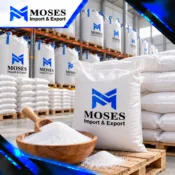
Buying salt in bulk sounds straightforward until the quotation stage.
Two suppliers may both offer “bulk salt,” yet one quote may refer to table salt in 25 kg bags while another covers industrial rock salt in jumbo bags. Grain size, application, packaging, order volume, and shipping terms can all change the commercial offer.
Moses Salt Co. supplies Egyptian table salt, sea salt, rock salt, pink salt, and other edible and industrial salt products for international buyers. Its current bulk-salt range also covers products for water treatment, road de-icing, food service, agriculture, industry, and animal feed.
For an importer, the useful starting point is therefore not simply: “What is your cheapest salt?” It is:
What type of salt do I need, in what specification, packaging, quantity, and shipping term?
That distinction makes it much easier to compare salt wholesale suppliers on equivalent offers rather than price alone.
Table of Contents
What Types of Bulk Salt Can You Buy?
The right bulk salt depends first on what the product will be used for.
The existing Moses Salt Co. article identifies several commercial categories.
Table Salt and Food-Service Salt
Food-service salt is supplied for restaurants, food processors, catering operations, and other commercial food applications.
When buying table salt at wholesale scale, the discussion should go beyond the name of the product.
A buyer should define at least:
- required salt type;
- intended food application;
- grain size;
- order quantity;
- packaging format;
- destination;
- shipping terms.
This is particularly important when the priority is an economical product for a large order. “Cheap” should describe commercial efficiency, not an undefined reduction in specification.
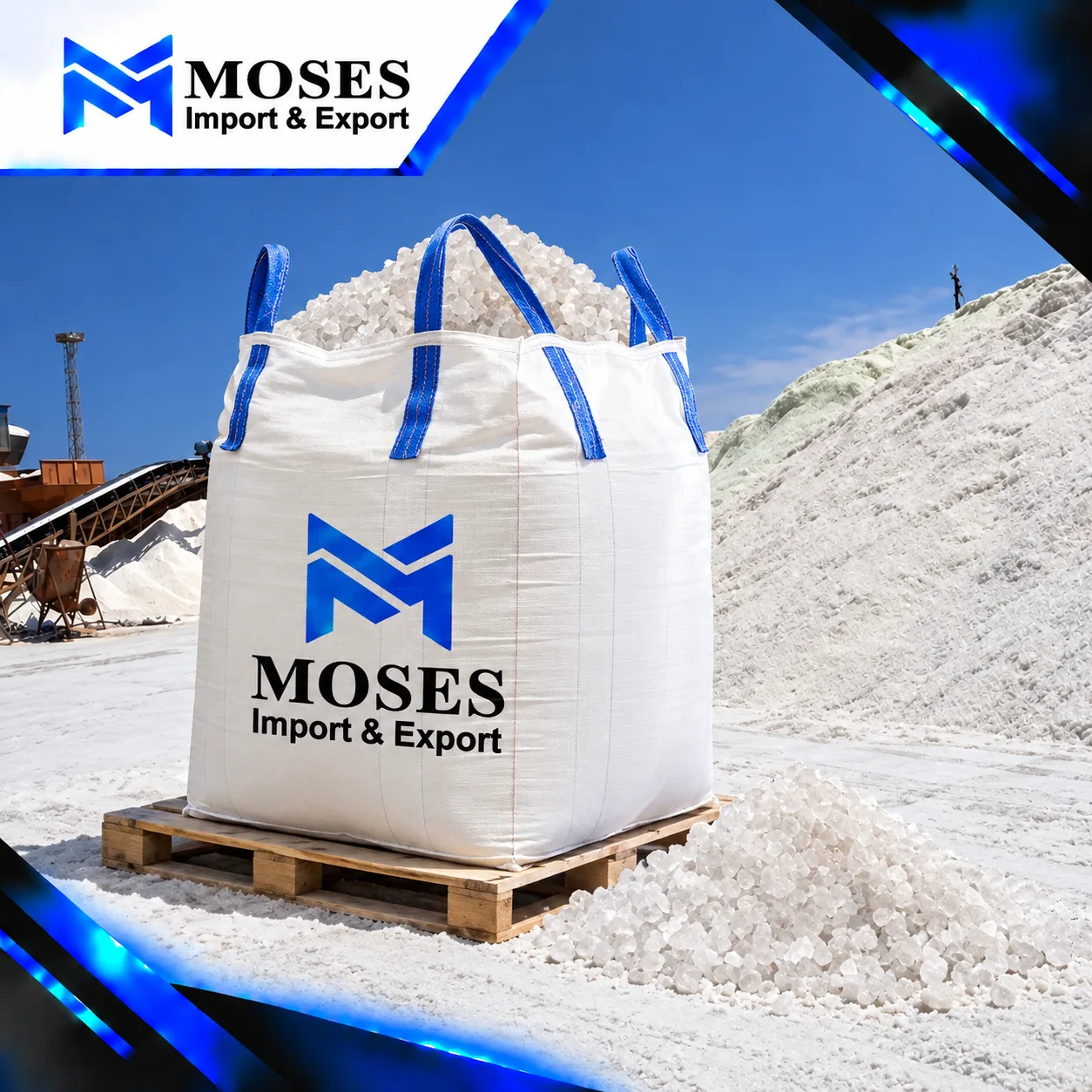
Wholesale Egyptian salt prepared in bulk quantities for importers, distributors, and global businesses
Sea Salt
Sea salt can be purchased for food and other applications depending on the required grade.
Buyers comparing suppliers should clarify the actual product specifications rather than assuming that every product marketed as sea salt is interchangeable.
Packaging and shipment size also matter. A distributor purchasing bagged salt has a different handling requirement from an industrial buyer receiving high-volume shipments.
Rock Salt
Rock salt is relevant to several bulk applications, including road de-icing.
The source article specifically describes bulk rock salt as a product supplied for melting snow and ice in European and U.S. winter markets.
For this type of order, quantity, packaging, loading method, and delivery planning may be just as important as the unit price.
Industrial Salt
Industrial salt is supplied for uses such as chemical manufacturing, detergent production, textile processing, and other industrial applications identified in the source article.
An industrial buyer should avoid treating the phrase “industrial salt” as a complete specification.
The required product should be discussed according to the actual process and purchasing requirements.
Water-Treatment Salt
Moses Salt Co. also lists salt for water-softening and purification applications within its bulk product range.
Here again, the intended system should be clear before an order is finalized.
Agricultural and Animal-Feed Salt
The company’s listed range also includes salt for agricultural and animal-feed applications.
These products should be purchased according to their intended use rather than grouped automatically with food-service or industrial salt.
Bulk Salt Packaging: The Cheapest Format Is Not Always the Same
Packaging has a direct effect on handling, storage, distribution, and logistics.
The existing article lists several formats for wholesale orders:
| Packaging format | Typical commercial purpose described by Moses |
|---|---|
| 25 kg bags | Easier handling and distribution |
| 50 kg bags | Larger bagged wholesale orders |
| 1-ton jumbo bags | High-volume purchasing with less packaging |
| Loose bulk in containers | Large-volume bulk shipments |
| Bulk vessel shipments | Very large industrial or de-icing orders |
These are the packaging options currently described by the company.
A lower-cost packaging format may make sense for one buyer and create extra handling costs for another.
For example, a large industrial customer may prioritize fewer packaging units, while a distributor may need bags that are easier to store, move, and resell.
That is why a useful quotation for salt in bulk should specify the packaging, not simply a price per ton.
What Does Commercial Bulk Salt Delivery Involve?
Commercial bulk salt delivery is more than moving salt from a factory to a port.
For an international order, the commercial discussion may include:
- product preparation;
- packaging;
- loading;
- shipment volume;
- freight terms;
- destination port;
- insurance where applicable;
- export documentation.
Moses Salt Co. states that it provides supply-chain and packaging support and offers CIF arrangements in which cost, insurance, and freight to the specified destination port are included under the agreed shipping term. The same page also refers to FOB quotations during the ordering process.
This is an important point when comparing quotations.
A factory-level price and a CIF price are not comparable numbers.
Before deciding that one supplier is cheaper, check what each quotation actually includes.
FOB or CIF: Know What You Are Comparing
The source page refers to both FOB and CIF as available quotation structures.
That changes how a buyer should read the price.
With one quotation, the buyer may be responsible for more of the freight arrangement. With another, transportation and insurance to the agreed destination port may form part of the quoted terms.
So instead of asking only:
“What is your bulk salt price?”
A better enquiry is:
“What is the price for this specification, packaging, quantity, destination, and Incoterm?”
That produces a figure that can actually be compared.
How to Request a Wholesale Salt Quotation
The existing Moses Salt Co. ordering process is relatively direct: send the enquiry, receive a quotation, confirm the order, and proceed to preparation and shipping.
The quality of the first enquiry matters, though.
A useful request should include:
- Salt type.
- Intended use.
- Required quantity.
- Preferred packaging.
- Destination country.
- Destination port.
- Required shipping term.
- Any specific product requirements.
A message saying “Send me your best bulk price” leaves several important variables unresolved.
A message saying “I need table salt in 25 kg bags for this quantity and destination port” gives the supplier something concrete to quote.
Cheap Bulk Table Salt for Spain
Buyers searching for a cheap version of table salt for bulk buying in spain are usually comparing the economics of a large order, but price should still be tied to a defined product and shipment.
The Moses article confirms wholesale food-service salt, multiple bulk packaging formats, and international export supply, but it does not provide a separate Spanish specification or fixed Spain-specific price.
For a Spain-bound enquiry, specify the table-salt grade you need, volume, packaging, and destination before comparing offers.
This prevents an apparently cheaper quote from representing a different pack size or shipping basis.
Cheap Bulk Table Salt for the Netherlands
The same principle applies to a cheap version of table salt for bulk buying in netherlands.
The original page discusses supply to European markets generally, rather than publishing a separate Netherlands product or quotation.
A Dutch importer should therefore request a quotation against a precise commercial requirement rather than expect one universal European price.
At minimum, match:
- product;
- quantity;
- packaging;
- shipping term;
- destination.
Only then is the price comparison useful.
Cheap Bulk Table Salt for Germany
For buyers looking for a cheap version of table salt for bulk buying in germany, order scale and logistics matter alongside the salt itself.
Germany falls within the wider European market addressed by the source article, which also discusses European demand for road and bulk salt. However, the page does not state a fixed German table-salt price or Germany-specific specification.
The practical route is to request a country-specific quotation based on the actual order rather than treating “cheap bulk salt” as one standardized product.
Cheap Bulk Table Salt for Lithuania
A search for a cheap version of table salt for bulk buying in lithuania presents the same purchasing question from another destination.
The source confirms international bulk supply and flexible packaging, but not a unique Lithuanian offer.
If the objective is to reduce landed cost, compare the complete commercial offer rather than the salt price in isolation.
A lower packaging cost, for example, may not result in the lowest total cost if freight or handling changes.
How to Compare Salt Wholesale Suppliers
The lowest quoted number does not necessarily identify the best commercial offer.
When comparing salt wholesale suppliers, place the quotations side by side and check whether they refer to the same thing.
| Comparison point | Why it matters |
|---|---|
| Salt type | Table, sea, rock, and industrial salt are different products |
| Intended application | Determines which product you actually need |
| Quantity | Larger orders may use different packaging or shipping structures |
| Packaging | Influences handling and logistics |
| Grain specification | Helps determine whether the offers are equivalent |
| Shipping term | FOB and CIF quotations include different responsibilities |
| Destination | Freight changes with the shipment route |
| Quality documentation | Should match what is required for the order |
| Delivery arrangement | Matters for commercial planning |
If one supplier quotes loose industrial salt and another quotes food-service salt in 25 kg bags, the two prices should not be treated as competing quotations.
They represent different orders.
Quality Control: Ask for Specifics, Not Adjectives
The original page states that Moses Salt Co. conducts purity, grain-size, and moisture checks and says its salt complies with international export standards. It also states that the company holds internationally recognized quality certifications, although that particular page does not identify the certificates by name.
That last point is important for a buyer.
Do not stop at phrases such as:
- premium quality;
- certified;
- export quality;
- high purity.
Ask which specification and documents apply to your product and shipment.
A measurable specification is more useful than a broad quality claim.
Choosing the Right Packaging for Bulk Salt
There is no single packaging option that is automatically best for every order.
25 kg and 50 kg Bags
These can be practical where individual handling and distribution matter.
They may suit wholesalers, commercial users, and businesses that need bagged stock rather than one large bulk unit.
One-Ton Jumbo Bags
The company positions jumbo bags as a more economical option for large orders, with less packaging relative to the quantity supplied.
They may make sense when the buyer has suitable equipment for handling larger units.
Loose Container Shipments
Loose bulk can reduce dependence on individual bags for high-volume purchases.
The buyer should still consider unloading, storage, and handling at destination.
Bulk Vessel Shipments
The source presents bulk vessels as an option for very large industrial and de-icing salt importers requiring continuous or high-volume supply.
At this scale, logistics planning becomes a central part of the transaction rather than an afterthought.
Bulk Salt for Food, Industry or Roads: Start with the Use
One of the weaknesses of generic bulk-salt enquiries is that they begin with quantity before application.
The order should usually be defined in the opposite direction:
Use → product → specification → packaging → quantity → shipment.
A food processor does not buy salt on the same basis as a road-maintenance operation.
An industrial plant does not necessarily need the same product as a restaurant distributor.
They may all buy bulk salt, but commercially they are buying different products.
Buying Salt in Bulk: Define the Order Before Comparing the Price
The phrase salt in bulk covers a wide range of commercial purchases.
It may mean table salt in 25 kg bags, industrial salt in jumbo bags, loose rock salt in a container, or a large vessel shipment for de-icing applications.
That is why finding good salt wholesale suppliers is not simply a search for the lowest price per ton.
A useful comparison starts with the same:
product, specification, quantity, packaging, shipping term, and destination.